Uptown Dallas Mixed-Use Leasing Strategy for Retail
April 2, 2026
April 2, 2026
Uptown retail is not getting bigger in a simple, one-size-fits-all way. It is getting smarter, denser, and more tied to how people live, work, dine, and move through the neighborhood. If you are evaluating retail space in Uptown, Dallas, that shift matters because it changes what makes a location perform. Let’s dive in.
In Uptown, retail demand is increasingly shaped by mixed-use development rather than standalone shopping centers. According to PwC’s Dallas market overview, nearly 75% of the 2.7 million square feet under construction in the office pipeline is concentrated in Uptown and Turtle Creek.
That matters because more office, residential, and hospitality density usually means more daily foot traffic near ground-floor retail. It also means retail tenants need to think beyond square footage and focus more on timing, access, and the surrounding tenant mix.
Uptown has regained and, in some cases, exceeded pre-pandemic activity. Cushman & Wakefield’s analysis using Placer.ai data found Uptown foot traffic at 110% of pre-pandemic levels in Q3 2024.
That sounds like a broad win for retail, but the bigger takeaway is that not all traffic behaves the same way. Uptown functions as a daypart market, which means traffic and spending patterns change based on the hour of the day and the mix of nearby office workers, residents, and visitors.
Some concepts depend heavily on weekday office traffic. Coffee shops, lunch-driven food uses, and quick in-and-out services often benefit most from direct office adjacency.
Other concepts perform better when people have more time to linger. Dinner, beverage, wellness, and impulse-oriented retail often rely more on evening activity, weekend traffic, and nearby residential density.
A North Central Texas Council of Governments parking study found that mixed-use West Village sites peaked during weekday evenings and weekend lunch hours rather than the classic midday office peak. For tenants, that is a useful reminder that the busiest block at noon may not be the best block for your business overall.
Several major Uptown projects show how retail is being built into a broader live-work-visit pattern.
Maple Terrace combines 345 rental units, 157,000 square feet of Class-AA office, and 15,000 square feet of street-level restaurant space. That kind of setup gives retail users multiple customer sources in one place, including residents, office users, and visitors.
For a tenant, that can create steadier activity across the day. It also raises the importance of matching the concept to the building’s internal rhythm, not just the address.
The QUAD delivered in 2024 with a 345,000-square-foot Class AA office tower, 15,000 square feet of retail across seven restaurants, a renovated office tower, and more than an acre of shared greenspace.
That matters because co-tenancy is part of the value. In a project like this, your neighbors can help create the destination effect that drives repeat visits and longer dwell times.
23Springs adds another strong example, with 625,000 square feet of office, 17,000 square feet of restaurant space, a half-acre park, and underground parking. The project reinforces a clear Uptown pattern: premium office density paired with restaurant and public-space activation.
For retail tenants, this usually supports food, beverage, and service uses that benefit from both professional daytime traffic and after-hours visibility.
McKinney & Olive offers 507,000 square feet of office, 50,000 square feet of retail, and a one-acre piazza. It was described as 99% leased when acquired in 2022, which points to the strength of well-executed mixed-use product in Uptown.
Its tenant mix also shows what works in this environment: destination food, wellness, and service uses that benefit from a polished office base and strong street presence.
West Village remains one of Uptown’s clearest retail case studies. The district has grown to more than 275,000 square feet and more than 100 shops, restaurants, and personal-care retailers, with more than 5,000 residents within walking distance.
It also benefits from access to DART Rail, the M-Line Trolley, and the Katy Trail. That mix helps explain why West Village continues to work as a lifestyle-centered, walkable retail district rather than just a collection of storefronts.
The next wave of projects appears to be reinforcing, not changing, Uptown’s retail direction. According to The Dallas Morning News, the long-discussed Central Market project on McKinney Avenue is moving forward, while 3100 McKinnon is planned for a mixed-use conversion with office, retail, and residential uses. The same report notes that Monclaire Hotel and Residences would place retail and restaurants on the ground floor if approved.
For retail tenants, that signals continued concentration of activity in places where uses are layered together. In practical terms, Uptown is becoming more specialized and more dependent on context.
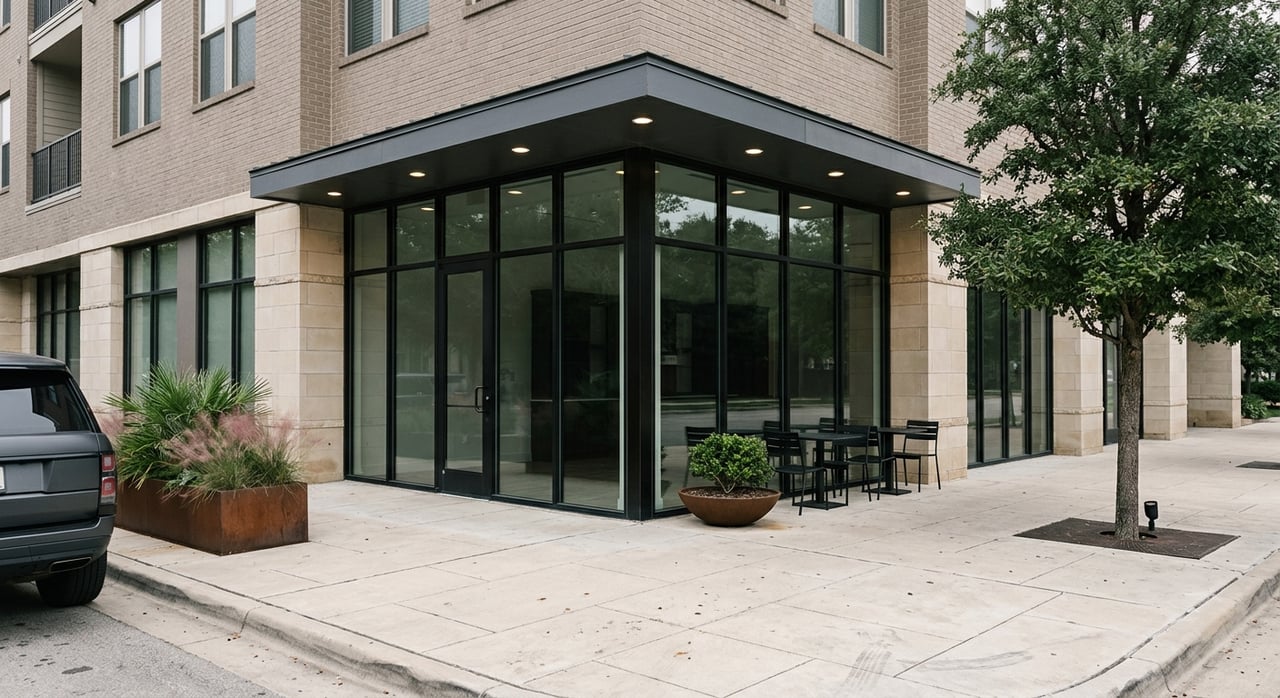
Parking still matters in Uptown, but it is no longer the only lens that matters. Visibility, pedestrian flow, curb access, and transit connections can be just as important, especially for smaller-format spaces.
Dallas has also changed the parking conversation. Under the city’s 2025 parking reform, there are no minimum parking requirements for the first 2,500 square feet of restaurant space, and the Street Seats program allows up to two street parking spaces to be converted into usable dining or retail space.
That gives landlords and tenants more flexibility. It can especially benefit food and beverage concepts that value storefront activation and street presence over a large dedicated parking field.
The NCTCOG study found that shared-parking models predicted demand more accurately than fixed on-site supply in mixed-use settings like West Village. That is important because office, residential, and dining uses often peak at different times.
In a district like Uptown, shared parking can make a site more functional than a single-use property with the same raw square footage. For tenants, that can widen the pool of workable locations.
The M-Line Trolley links the Dallas Arts District with Uptown shops, West Village, and Cityplace/Uptown Station, and it runs seven days a week. That adds another layer of customer access beyond driving.
The best street-front spaces are often the ones that sit along obvious pedestrian routes or transit paths. In Uptown, frontage, signage, drop-off convenience, and trail or trolley connectivity can have more impact than parking count alone.
Uptown is still a premium retail node, and rent expectations reflect that. A 2024 CoStar-based appraisal cited in an SEC filing reported 7.9% vacancy and market rent of $35.14 per square foot in the Uptown retail submarket.
By comparison, CBRE reported through the same source context in the research that Dallas retail averaged $20.83 per square foot in net asking rent in Q1 2025. The spread suggests that Uptown can support higher rents, but only when the location quality truly justifies the premium.
If you are comparing locations, a simple checklist can help you avoid overpaying for the wrong type of exposure.
Not every retail format fits every Uptown location. A quick comparison can help frame the choice.
| Location Type | Often Best For | Key Strength |
|---|---|---|
| Lifestyle-center space | Destination dining, personal services, longer-visit concepts | Shared parking, curated co-tenancy, dwell time |
| Street-front space | Coffee, quick-service, service retail, high-visibility uses | Frontage, signage, curb access, pedestrian capture |
Projects like West Village, The QUAD, and Maple Terrace illustrate the lifestyle-center model well. McKinney & Olive and 23Springs help show why strong street presence can also command attention in the right setting.
Uptown’s mixed-use growth is not making retail more generic. It is making it more selective.
The best-performing spaces are likely to be the ones that align with how people actually use the district by time of day. If you understand the daypart, the co-tenancy, and the access story behind a site, you are in a much better position to choose a space that supports long-term performance.
If you are weighing a retail opportunity in Uptown or need a sharper read on how a mixed-use location fits your goals, Grant Gold brings a data-driven, high-touch perspective shaped by real Dallas mixed-use and leasing experience.
Stay up to date on the latest real estate trends.
Get assistance in determining current property value, crafting a competitive offer, writing and negotiating a contract, and much more. Contact me today.